
AbstractCollection Class in Java
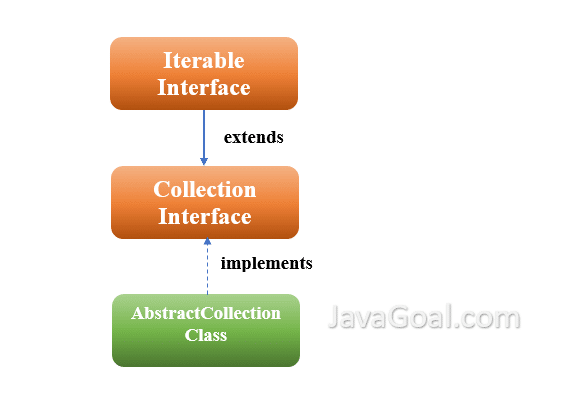
AbstractCollection is part of the Java Collection Framework and implements the Collection interface. It offers a skeletal implementation of that interface, providing ready-made versions of several methods so you don't need to code each one yourself. Put simply, it cuts down the work involved in creating your own collection.
The class is declared as public abstract class AbstractCollection<E> implements Collection<E>, where E represents the type of elements the collection stores.
Benefits of Using AbstractCollection
- Unmodifiable collections: To build a collection that cannot be changed (like an immutable list), extend AbstractCollection and implement just the
iterator()andsize()methods. - Modifiable collections: For a collection that can be changed (such as an ArrayList), you need those same two methods plus an override of
add(). Without that override, callingadd()throws anUnsupportedOperationException.
Constructor
A default constructor is available, but because it is protected you cannot create an AbstractCollection instance directly.
Continue Learning Java
Browse more topics in the JavaGoal library, ranging from control structures and OOP concepts to collections and exception handling.


Join the Discussion
Have a question or an insight about this topic? Share it in the comments below.
Leave a CommentExplore More Java Tutorials
- Control structures in Java
- Java control statements
- if statement in Java
- Nested if statement in Java
- If else if ladder statement in Java
- Switch statement in Java
- Nested switch statements in Java
- Switch case with char
- Switch case with wrapper classes
- Loops in Java
- break statement in Java
- continue statement in Java
- Java Array
- Two dimensional array in Java
- Array of objects in Java
- Array default value in Java
- OOPs concepts in Java
- Class and object in Java
- Constructor in Java
- Constructor overloading in Java
- Constructor chaining in Java
- Inheritance in Java
- Multiple inheritance in Java
- Inheritance rules
- Method overriding rules in Java
- Inheritance vs composition
- Polymorphism in Java
- Method overloading in Java
- Method overloading example
- Can we overload a static method in Java
- Method overriding in Java
- Can we override the final method in Java
- Can we override the static method in Java
- Abstraction in Java
- Abstract class in Java
- Abstract method in Java
- When to use an abstract class
- Abstract class vs concrete class
- Can an abstract class be final in Java
- Can an abstract class have a constructor
- Interface in Java
- Multiple inheritance using interfaces in Java
- When to use abstract class and interface
- Encapsulation in Java
- Association in Java
- Access modifiers in Java
- Packages in Java
- import in Java
- enum in Java
- Wrapper class in Java
- Immutable class in Java
- final keyword in Java
- final variable in Java
- final reference variable
- final method in Java
- final class in Java
- final, finally and finalize
- static keyword in Java
When you extend AbstractCollection, the class handles most of the Collection interface for you, so you only supply the methods your collection truly needs. Start with iterator() and size(), then override add() only if your collection should support modification. This makes AbstractCollection a practical starting point for building custom collection types in Java.