
AbstractSet in Java: A Ready-Made Skeleton for Set Implementations
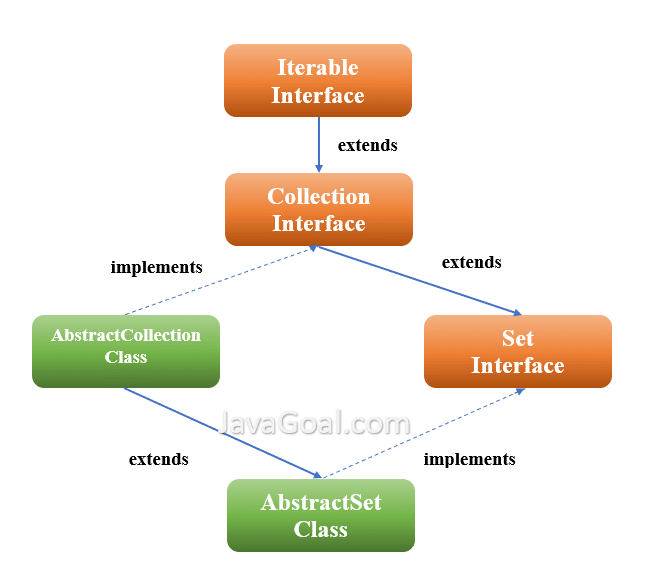
AbstractSet is part of the Java Collection Framework. By extending AbstractCollection and implementing the Set interface, it hands developers a ready-made base on which to build their own set implementations.
Its declaration reads: public abstract class AbstractSet<E> extends AbstractCollection<E> implements Set<E>
Since AbstractSet offers a skeletal implementation of the Set interface, it cuts down the code you need to write when creating a custom set. It inherits from AbstractCollection without overriding any of that class's implementations, and it adds concrete versions of the equals() and hashCode() methods.
Important Points to Keep in Mind
- AbstractSet is an abstract class that implements the Set interface.
- Because it extends AbstractCollection, it inherits the collection framework's basic behavior.
- Its skeletal implementation keeps the effort of implementing Set to a minimum.
- It overrides none of the implementations inherited from AbstractCollection.
- It provides implementations of the equals() and hashCode() methods.
Keep Learning Java
Dig into more topics in the JavaGoal tutorial series, ranging from control structures and OOPs concepts to collections and exception handling.


Join the Conversation
Got a question or a tip about the AbstractSet class? Share it with us below.
Leave a Comment
Discover More Java Topics
Control Structures
- Control structures in Java
- Java control statements
- If statement in Java
- Nested if statement in Java
- If else if ladder statement in Java
- Switch statement in Java
- Nested switch statements in Java
- Switch case with char
- Switch case with wrapper classes
Loops and Jump Statements
Arrays
OOPs Concepts
- OOPs concepts in Java
- Class and object in Java
- Constructor in Java
- Constructor overloading in Java
- Constructor chaining in Java
- Inheritance in Java
- Multiple inheritance in Java
- Inheritance rules
- Method overriding rules in Java
- Difference between inheritance and composition
- Polymorphism in Java
- Method overloading in Java
- Method overloading example
- Can we overload a static method in Java
- Method overriding in Java
- Can we override the final method in Java
- Can we override the static method in Java
Abstraction and Interfaces
- Abstraction in Java
- Abstract class in Java
- Abstract method in Java
- When to use the abstract class
- Difference between abstract class and concrete class
- Can an abstract class be final in Java
- Can an abstract class have a constructor
- Interface in Java
- Multiple inheritance using interface in Java
- When to use abstract class and interface in Java
Encapsulation, Packages and Modifiers
- Encapsulation in Java
- Association in Java
- Access modifiers in Java
- Package in Java
- Java import package
- enum in Java
- Wrapper class in Java
- Immutable class in Java
final and static Keywords
When you build a custom set, extending AbstractSet lets you focus on the storage logic while the class handles the Set contract for you. Its equals() and hashCode() implementations mean two sets are compared by their contents rather than by identity, which is usually what you want.